


CELLULITE
What is Cellulite
Basically, cellulite is enlarged, clumped lipids surrounded by a mixture of water and toxins. This results in an uneven skin structure. Each type of cellulite has these basic features, but due to the detailed mechanism of the formation of changes, we can distinguish fatty, water and circulating cellulite.There are many reasons for the formation of cellulite, as well as the conditions that favor its development, and it is difficult to clearly define one root cause. Typically, this disease is caused by a number of overlapping factors. Starting from a bad diet, lack of exercise, through genetic determinants, ending with the hormonal balance. In recent years, there is a tendency for cellulite to affect younger and younger women. Neither is the condition associated with menopause and obesity as originally thought, but it also occurs in lean girls during their adolescence. As it turned out, this is influenced by genes. It is genes that determine whether our fat cells have fewer or more fat-binding receptors. The development of cellulite is favored by a sedentary lifestyle, lack of exercise and a bad diet.
Types of cellulite
- Fatty cellulite
The cause of fatty cellulite is the excess of fat cells. This can happen if you suddenly gain weight. The enlarged lipids are surrounded by a mixture of water and toxins that further stimulate lipid growth. On the other hand, the lumps of fat pressurize the capillaries, which means that they are not able to efficiently remove toxins and water from the tissues, and the problem becomes even worse.
- Water cellulite
Water cellulite is a problem that primarily affects slim people. The immediate cause is impaired blood and lymph circulation. As a result, the tissues retain water and toxins. Surrounded by them, the lipids grow more and more and unevenness appears on the skin.
- Circulating cellulite
Circulating cellulite is a combination of fatty and water cellulite. Its appearance is equally due to problems with microcirculation and an increase in adipose tissue. This situation may occur if you increase your weight significantly and lead a sedentary lifestyle.
Cellulite formation stages
In anti-cellulite treatments, it is of great importance at what stage of the formation of changes we start our fight. The more advanced the orange peel is, the harder it is to get rid of it. In the first stage, the change in structure is visible only after squeezing the fold of the skin with your fingers. In the second stage, the orange peel is observed in certain positions, e.g. sitting on a hard chair. In the last stage, changes are visible regardless of the body position. Then the fight against cellulite is extremely difficult.
How to get rid of cellulite
- Mesotherapy
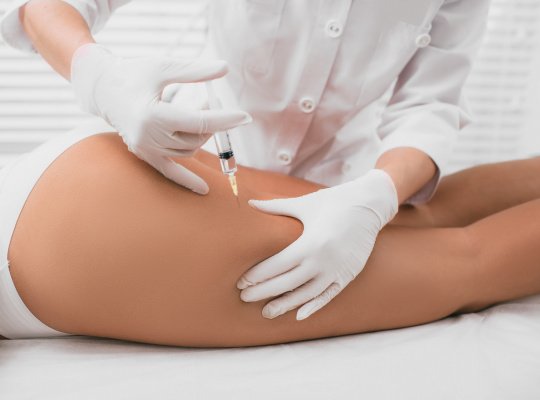
Mesotherapy consists in injecting a suitable preparation into the tissue covered with cellulite, which will break down the lumps. Hyaluronic acid contained in the preparation releases the accumulated fat and makes the skin soft and smooth. After needle mesotherapy, slight swellings, bruises or small lumps may appear on the skin. They usually disappear within hours or days. In order to achieve the best results, it is recommended to perform 3-5 treatments with an interval of one or two weeks and to repeat the mesotherapy as an adjunct every 6 months.
- Microneedle radiofrequency
Microneedle radiofrequency consists in simultaneous puncturing of the skin with micro-needles and heating with electromagnetic radiation. Microneedle radiofrequency allows you to accurately determine the scope of the procedure by puncturing the skin to the desired depth, up to 3.5 mm. At the same time, it works more effectively than classic lasers that reach no deeper than 1.7 mm. In microneedle radiofrequency, we precisely regulate not only the range of the treatment, but also the time and intensity of tissue heating. The effects of using the described method are very good, and in some cases even amazing. It is worth emphasizing that treatments with the use of radio waves are one of the most effective methods in the fight against cellulite and excessive amount of adipose tissue. They reach the adipocytes, which under the influence of the generated temperature break down and dissolve. The lymphatic and circulatory systems are also stimulated, which leads to the acceleration of metabolism in the tissues and causes their better nourishment. To achieve the best results, it is recommended to perform 3 treatments every 4 weeks and repeat it as an auxiliary every 6 months
- Endermology
Endermology is a procedure that works in a very similar way to lymphatic drainage. However, this anti-cellulite massage uses a special device with a head equipped with massage rollers. During the procedure, in order to avoid greater discomfort and bloody spots on the skin, the client is wearing a special protective suit.
The skin fold is sucked by the head of the massage device and then subjected to the action of rotating rollers. Endermology, by stimulating blood and lymph circulation, smoothes the skin and makes it more elastic. The effects are visible after 4-5 treatments, but endermology is recommended in a series of 10 treatments.
- Carboxytherapy
This cellulite treatment involves the intradermal or subcutaneous injection of small doses of carbon dioxide. When carbon dioxide is introduced into the skin, it increases the flow of blood, nutrients, and oxygen to the area. It also stimulates cell renewal and collagen production.
The effect is not only to improve the condition of the skin injected with carbon dioxide, but also to break down fatty deposits. During carboxytherapy, the gas changes into carbonic acid, which destroys fat cells.
For a satisfactory effect, 10 treatments are recommended.
The latest research shows that as many as 90% of women over the age of 25 struggle with this problem - not only those who are overweight, but also in slim and even athletic women.
It is most often located on the thighs, buttocks, abdomen, hips, and in some cases also on the shoulders and above the knees.